


How Matthew 18 is Often Misused - and What Jesus Actually Meant

Updated: Jan 26

1. Not a Stopwatch-A Shepherd’s Path
For many Christians, Matthew 18 has quietly become a kind of procedural checklist - a three‑step conflict‑management sequence we recite almost automatically: go to them, bring witnesses, tell the church. We often use it like a built‑in eject button, assuming Jesus handed us a formula for getting difficult people out of our lives or out of our communities. If someone won’t listen, well, that’s that.

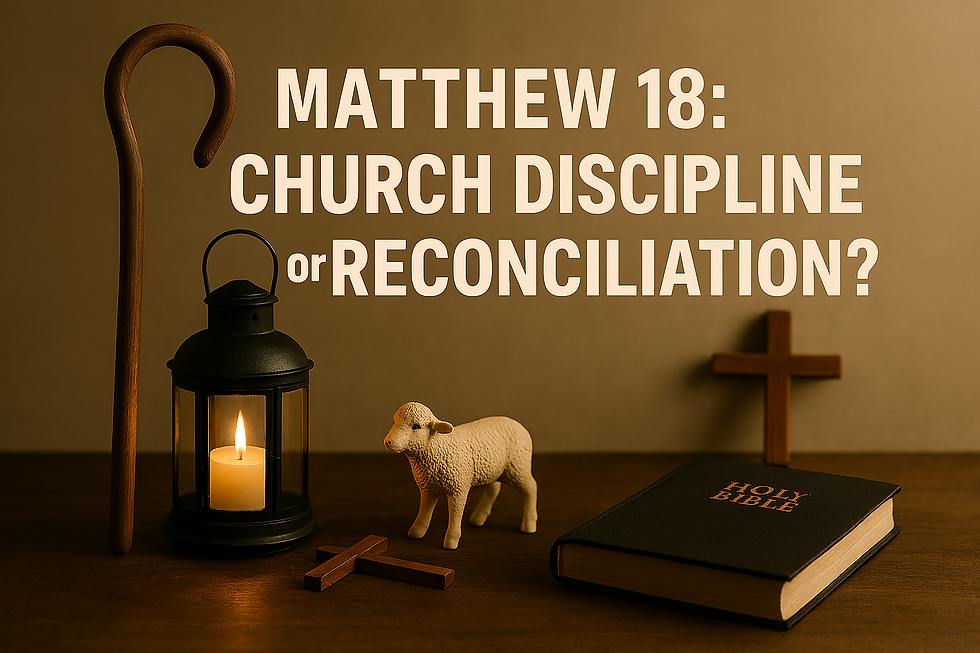
But anyone who reads Matthew 18 from the beginning - slowly, attentively, inside the full melody of the chapter - will notice something very different. This isn’t a passage fueled by hurry, humiliation, or institutional control. It’s the sound of shepherding. It’s the sound of a Father who fiercely protects the vulnerable. It’s the sound of a Savior who goes after the wandering one, not to shame them, but to bring them home.
And when you hear the whole chapter, you begin to realize: Jesus didn’t give us Matthew 18 to push people out. He gave it to help us bring people back.
That’s why the blog begins here - with an invitation to breathe, slow down, and listen again to the heart of the Shepherd. Before Jesus ever talks about confronting sin, He talks about humility. Before He mentions witnesses or church involvement, He talks about protecting “little ones” and pursuing wandering sheep. Before He outlines any steps, He establishes the tone: gentleness, compassion, slowness, and determined love.
So if Matthew 18 has ever felt like a tool that increases pressure rather than peace, or if you’ve seen it misused in ways that wound people rather than restore them, this journey is for you. My hope is simple: that together we would rediscover what Jesus actually meant - and allow His voice, not our urgency or frustration, to shape how we walk into conflict.
Because Matthew 18 isn’t a hammer. It’s a healing path. And Jesus invites us to walk it with Him.
2. Reading Matthew 18 in Its Full Context To Understand How Matthew 18 is Often Misused
Before we touch Jesus’ instructions about confronting a brother or sister, we need to step back and listen to the whole chapter. Matthew 18 is not a troubleshooting manual dropped into the middle of the Gospel - it is a unified teaching about humility, protection, repentance, mercy, and the Shepherd who refuses to give up on the wandering one. If we read the correction steps without hearing this melody, we are almost guaranteed to misuse them. (See: What Matthew 18 Really Teaches About Church Discipline)
Everything starts with a question from the disciples: “Who is the greatest in the kingdom of heaven?” (Matthew 18:1)
It’s a question rooted in comparison, hierarchy, and human notions of spiritual status. But Jesus answers in a way that collapses their assumptions - He calls over a child. Not a symbol of cuteness or innocence, but a picture of neediness, dependence, and vulnerability.
Then He says: “Unless you turn and become like children… whoever humbles himself like this child is the greatest.” (vv. 3–4)
This is the first note of the entire chapter: Greatness begins with humility. Greatness is neediness embraced, not competence displayed. Greatness is dependence on grace.
Everything that follows flows from this posture.
Immediately afterward, Jesus warns His disciples: “See that you do not despise one of these little ones.” (v. 10)
Who are the “little ones”? Not just children, but all who are spiritually fragile - those who are discouraged, vulnerable, anxious, drifting, or newly believing. Jesus directs His disciples’ attention toward the very people the world overlooks. He insists that every single one of them matters profoundly to the Father.
Then Jesus tells the story that sets the emotional tone for the whole chapter - the parable of the wandering sheep (vv. 12–14). The shepherd leaves the ninety‑nine and searches for the one who has strayed, not with irritation, but with relentless compassion. And when he finds it, he doesn’t scold it. He rejoices.
Jesus ends the story of the wandering sheep with this breathtaking statement:
“It is not the will of my Father who is in heaven that one of these little ones should perish.” (Matthew 18:14)
That single sentence is the heartbeat of the entire chapter. It is the interpretive key. It is the lens through which the rest of Matthew 18 must be understood.
Before Jesus ever mentions confronting sin, before He talks about witnesses, before He speaks of involving the church, before He describes treating someone as a Gentile or tax collector -
He shows us the Father’s will: that not one wandering, struggling, vulnerable person would be lost.
This is why Matthew 18 cannot be reduced to a conflict‑management checklist. It is a shepherding chapter, beginning to end.
So what does this mean for how we read the correction steps?
It means:
Correction must be anchored in humility, because the greatest in the kingdom are the most dependent (vv. 3–4).
The goal is to protect the little ones, not to expose or embarrass them (v. 10).
The motivation is to pursue the wandering sheep, not to win an argument (vv. 12–14).
The tone must reflect the Father’s will, which is rescue, not rejection (v. 14).
By the time we reach verse 15 - “If your brother sins against you, go…” - we should feel the warmth of the Shepherd’s heart. We should hear gentleness in Jesus’ voice. We should sense the urgency of love, not the urgency of procedure.
The context re-forms the entire meaning:
The private conversation in verse 15 is not an ambush - it is a shepherd seeking the one.
The witnesses in verse 16 are not reinforcements - they are peacemakers who carry the Shepherd’s tone.
The church involvement in verse 17 is not public shaming - it is communal shepherding, done carefully, quietly, and protectively.
And even the final step - treating someone as a Gentile or tax collector - is not rejection, because Jesus Himself welcomes, eats with, and calls Gentiles and tax collectors into His kingdom.
Matthew 18 is not a mechanism for removal. It is a map for redemption.
Until we absorb the whole chapter - its humility, its protection of the vulnerable, its pursuit of the wandering, and its floodgate of forgiveness - we will be tempted to use the steps as a process rather than as a pastoral journey making it difficult to see how Matthew 18 is often misused.
But once the context sinks in, something in us softens. We begin to see that Matthew 18 is not a cold directive for managing difficult people. It is a warm invitation to love people like Jesus does - slowly, gently, persistently, and with a heart that refuses to give up on the wandering one.
This is the ground on which all the later steps must stand. If we build Matthew 18 on any other foundation, we will misuse it.
3. Misuse #1 - Rushing the Process
One of the most common - and most damaging - misuses of Matthew 18 is the tendency to rush through it. We treat Jesus’ words like a stopwatch: Step one. Step two. Step three. Done. As if the point were to move quickly, complete the procedure, and check the box that says, “I did my part.” (See: Misapplications of Matthew 18:15-20)
But Jesus isn’t handing us a stopwatch. He’s inviting us into patience.
If the melody of Matthew 18 is humility, vulnerability, and shepherd‑like care, then rushing someone through a conflict conversation is already moving off‑key. The human heart - especially a hurting heart - rarely moves at the speed of our frustration. And whenever we hurry, we risk choosing efficiency over compassion, procedure over relationship, and outcome over love.
Scripture consistently calls us to a different pace.
Peter tells us, “The Lord is patient… not wishing that any should perish, but that all should reach repentance.” (2 Peter 3:9) If God Himself moves slowly for the sake of restoration, why should we expect the people we love to change quickly?
Paul echoes the same rhythm: “Restore him in a spirit of gentleness.” (Galatians 6:1) and “Walk with all humility and gentleness, with patience, bearing with one another in love.” (Ephesians 4:2–3)
These aren’t the words of efficiency. They’re the words of endurance, compassion, and long‑suffering mercy. They remind us that real reconciliation takes time, and that every step of Matthew 18 is meant to be walked with a heart that mirrors God’s patience toward us.
So before you begin a hard conversation - or in the moment when frustration tempts you to accelerate - the most important question you can ask is this: Am I moving at the speed of frustration, or the speed of love?
The speed of frustration pushes. It demands quick answers, quick repentance, quick resolutions. It grows impatient when someone hesitates, struggles, or doesn’t see the problem as clearly as we do.
The speed of love is different.
It pauses.
It listens.
It leaves space for the Holy Spirit to work in ways we cannot force.
Love is patient. Not theoretically, but practically. Not only when things are going smoothly, but especially when they’re not.
And here’s the beauty:
When we slow down, something changes - not just in the other person, but in us. Our tone softens. Our expectations recalibrate. We become safer people to talk to, easier people to approach, and more like the Shepherd who came after us when we were wandering.
Matthew 18 only works when we resist the urge to rush. Shepherds walk slowly. So must we.
4. Step One Done Right - The Private Conversation
When Jesus says, “If your brother sins against you, go and tell him his fault between you and him alone” (Matthew 18:15), He is not giving us permission to ambush someone, corner them, or shame them. He’s describing a posture - a relational, humble, heartfelt approach rooted in love. This is the step most people misunderstand, and when we get it wrong, everything downstream gets distorted.
Private means private.
A private conversation is not:
A group text.
A social‑media flare‑up.
A gossipy “prayer request” shared with others first.
A meeting where your real goal is to prove a point.
It is one person sitting down with another, face to face, at a pace and tone that honor their dignity. Private means alone, which also means it’s quiet, safe, and respectful. (See: Who is Responsible for Taking the First Step?)
And it begins not with accusation, but with humility.
Start with your heart, not their fault.
James gives us three simple but profoundly wise instructions: “Be quick to hear, slow to speak, slow to anger.” (James 1:19)
This is the opposite of how we naturally enter conflict. We’re often quick to speak, quick to assume, and quick to feel offended. But Jesus calls us to start with a deep, honest look inside: Before I talk to them about their sin, am I willing to acknowledge my part?
Jesus Himself teaches this in Matthew 7:3–5. He tells us to remove the log from our own eye first - not because the other person has no speck, but because humility clears our vision so we can love well. Entering the conversation with a posture of confession softens the soil of the relationship and prepares the way for grace.
A gentle opening like this changes everything:
“I value you, and I want to understand what happened. I might be missing something. If I’ve contributed to this, I want to own it.”
This is not weakness. This is Christlike strength.
Gentleness opens doors that forcefulness slams shut.
Proverbs 15:1 reminds us that “a soft answer turns away wrath.” You can feel this difference immediately. A sharp tone, a loaded question, or an accusatory posture tightens the room. A soft answer relaxes it. It signals safety. It signals love. It signals that your goal is reconciliation, not vindication.
And when gentleness meets honesty, something beautiful becomes possible: confession.1 John 1:8–9 reminds us that we all fall short - and that confession opens the door to mercy. When both hearts are open, a private conversation becomes a place where the Spirit begins to untangle fear, misunderstanding, and pain.
And if it doesn’t go well?
Don’t panic.
Don’t escalate.
And above all, don’t give up.
Paul’s words echo again: “with all patience” (Ephesians 4:2). Sometimes the first attempt doesn’t land. Emotions run high. Defensiveness shows up. The timing wasn’t right. The person didn’t feel safe yet. That doesn’t mean the process has failed - it means you take a breath, pray, and try again later with tenderness.
The Shepherd does not give up after one attempt at rescue. Neither should we.
A private conversation done right is one of the most powerful reconciling tools Jesus gives us. When approached with humility, gentleness, and patience, it becomes a sacred space where misunderstandings are cleared, wounds are soothed, and hearts begin to soften toward one another again.
This is the quiet, unseen, grace‑filled step where most conflicts can be healed - long before witnesses or leaders ever need to be involved.
5. Step Two - Bringing Witnesses as Reconcilers or Peacemakers
If the private conversation doesn’t lead to clarity, softening, or movement toward repair, Jesus gives us a second step:
“Take one or two others along with you.” (Matthew 18:16)
This is the step many people misunderstand or misuse - sometimes badly. Too often, “bringing witnesses” gets treated like bringing reinforcements, as if their job were to apply pressure, prove who’s right, or serve as backup in a relational showdown. But that’s not Jesus’ intent at all.
In Matthew 18, witnesses are not muscle. They are reconcilers. (See: Restoration in Scripture: An Act of Love)
The character of the witnesses matters.
Before you invite anyone into the room, ask yourself: Are these the kind of people who embody the heart of Jesus?
James describes the kind of wisdom that comes “from above”: “Pure, peaceable, gentle, open to reason, full of mercy… and a harvest of righteousness is sown in peace by those who make peace.” (James 3:17–18)
These are the people you want present - those who know how to listen, how to speak gently, and how to guide tense conversations toward hope rather than hostility. Their presence should lower the emotional temperature, not raise it.
Proverbs echoes this same principle:
“Without counsel plans fail, but with many advisers they succeed.” (Proverbs 15:22)
“If one gives an answer before he hears, it is his folly and shame.” (Proverbs 18:13)
Good witnesses don’t rush.
They don’t assume.
They don’t take sides.
They listen - and they help everyone in the room listen.
What witnesses actually do in the room.
The purpose of this step is not to secure a verdict. It is to help two people hear each other accurately and gently.
Reconcilers and Peacemakers:
Summarize what they’ve heard so each person feels understood.
Ask clarifying questions to untangle assumptions and perceptions.
Steer the tone toward humility, patience, and compassion.
Keep the focus on restoration rather than victory.
A simple question they can hold before everyone is: “What response would honor Jesus and strengthen this relationship?”
This reframes the conversation. It turns the attention away from the problem itself and toward the person, the relationship, and the One who has called us into unity.
Let the peace of Christ guide the next steps.
Paul writes, “Let the peace of Christ rule in your hearts.” (Colossians 3:15) This is not just a comforting phrase - it’s a directional one.
As clarity emerges, and as each person begins to feel heard, a path forward often reveals itself. And when it does, Scripture nudges us toward action:
“So then let us pursue what makes for peace and for mutual upbuilding.” (Romans 14:19)
Mutual upbuilding.
Not one person winning.
Not one person being vindicated.
Not one person being proven right.
Both people strengthened. Both people growing. Both people restored.
This is what the presence of wise witnesses can help make possible - a moment where grace breaks through, where truth is spoken gently, and where hearts that were formerly guarded begin to open.
When done well, Step Two is not an escalation. It’s a deepening of care. A widening of support. A loving invitation for both people to walk toward peace together.
And more often than not, this is the moment where genuine breakthroughs happen.
6. Step Three - “Tell It to the Church” Carefully
If the first conversation doesn’t lead to clarity, and the presence of gentle witnesses still doesn’t move the relationship toward understanding or repair, Jesus offers a third step:
“Tell it to the church.” (Matthew 18:17)
Unfortunately, this is the step that has caused some of the deepest wounds in Christian communities - not because Jesus’ instruction is harsh, but because we have often carried it out in ways that ignore the heart of the chapter.
Many people imagine this step as a kind of public announcement, a congregational expose, or a moment of institutional discipline. But Jesus never intended Matthew 18 to become a megaphone.
This is not about broadcasting someone’s failure. Not about gossip. Not about shaming. Not about proving a point.
“Tell it to the church” is about careful, wise shepherding.
Paul reminds us that “all things should be done decently and in order.” (1 Cor. 14:40) Solomon adds that “whoever goes about slandering reveals secrets, but he who is trustworthy in spirit keeps a thing covered.” (Proverbs 11:13)
Together, these passages paint a clear picture: Even in conflict, dignity must be guarded, and information must be handled with reverence and restraint.
So what does Jesus mean by “tell it to the church”? He means that when private attempts at reconciliation have been exhausted, you invite wise, spiritually mature leaders - shepherds - to enter the situation with careful, prayer‑soaked discernment.
The circle should remain as small as possible for as long as possible.
This is not the time to open the floodgates of information. It is the time for wise leaders to enter the story with tenderness.
These leaders:
Shepherd both people, not just one.
Protect the vulnerable, especially if one person is spiritually fragile or wounded.
Listen fully before speaking, resisting the urge to fix the situation quickly.
Keep the tone gentle and the conversation grounded in Scripture.
Set appropriate boundaries, not as punishment but as protection.
They enter not to judge, but to guide. Not to take sides, but to help both sides see clearly. Not to shame, but to shepherd.
Shepherding includes guiding the path toward repair.
At this stage, leaders may ask thoughtful questions like:
What would genuine repair look like here?
Are there practical steps that would rebuild trust?
Are there boundaries needed for safety or clarity?
Scripture gives us beautiful examples: When Zacchaeus repented, he made restitution - a tangible act of repair (Luke 19:8).Paul reminds us in Romans 13:1–4 that legitimate authority exists to protect, not to harm. And Proverbs 4:23 urges us to guard our hearts - a reminder that emotional and relational safety is not unspiritual; it’s wise.
Sometimes the most loving thing leaders can do is create clear, gentle structures that protect both people while giving space for reconciliation to unfold.
And sometimes - even with careful shepherding - the heart does not move.
Jesus acknowledges this possibility: “If he refuses to listen even to the church…” (Matthew 18:17)
But even here, the posture remains tender, not punitive. The way leaders carry this step can determine whether someone walks away feeling condemned - or feeling that the door of grace remains open if they ever return.
In other words: This step is not about escalating a conflict. It is about deepening care, widening support, and giving the Holy Spirit every possible opportunity to bring restoration.
Handled with humility, confidentiality, and compassion, Step Three becomes not a moment of exposure, but a moment of protective love - a place where wise shepherds guard dignity, discern next steps, and hold open the possibility of healing.
It is the furthest thing from a public spectacle. It is the Church doing what Jesus designed her to do: protect, restore, and guide with a gentle hand.
7. When Someone Still Won’t Listen
We all hope that by the time wise leaders have entered the conversation - with gentleness, clarity, prayer, and careful shepherding - the relationship will begin to heal. And often, it does. But Jesus acknowledges that sometimes, even after every loving attempt has been made, a person still refuses to listen.
“If he refuses to listen even to the church…” - Matthew 18:17
For many people, this is the moment Matthew 18 feels the harshest. It sounds like a breaking point, a relational dead end, a cue to close the door and walk away. But if we keep listening to Jesus, if we keep His heart in view, we realize something surprising:
This is not a command to shun. It is a call to adjust your posture - but not your love.
What Jesus doesn’t mean.
Jesus is not telling us to:
Cut the person off emotionally
Treat them as an enemy
Gossip about them
Create distance rooted in bitterness
Weaponize the relationship
Sadly, some churches have taken this step and used it as justification for rejection, humiliation, or permanent exclusion. But that response contradicts the entire melody of the chapter.
If Matthew 18 began with humility, little ones, a wandering sheep, and a shepherd who rejoices when the lost one returns, then we must carry that melody into this moment too. (See: I Need to be Reconciled to Others - and It Doesn't Matter Who Started It!)
So what does Jesus mean?
When Jesus says, “let him be to you as a Gentile and a tax collector,” He is describing a realistic, honest posture - recognizing that the relationship is no longer functioning in mutual trust or shared discipleship.
But ask yourself this: How does Jesus treat Gentiles and tax collectors?
He eats with them.
He calls them by name.
He invites them.
He protects them.
He seeks them when they wander.
He tells stories - like the father of the prodigal son in Luke 15 - where love keeps scanning the horizon for the first sign of return.
In other words, Jesus treats “outsiders” with persistent grace and open‑door love.
So this step is not the end of the relationship. It is an invitation to stay relationally open while being spiritually honest.
Warn as a brother, not as an enemy.
Paul captures this tension beautifully:
“Do not regard him as an enemy, but warn him as a brother.” - 2 Thessalonians 3:15
This is one of the most important verses for interpreting Matthew 18.
We hold boundaries because the person is refusing to listen - but we do not hold contempt. We name the reality without closing our hearts. We keep the door unlocked, even if for now it must remain partially closed.
What faithfulness looks like in this season.
When someone will not listen, your role becomes quieter but no less meaningful:
Keep loving. Love is never wasted, even when it is not immediately received.
Keep praying. Hearts can shift in ways we cannot see.
Keep your speech gracious. Paul urges us to let our words be “seasoned with salt” (Colossians 4:6).
Live at peace as far as it depends on you. (Romans 12:18)
You may not be able to restore the relationship right now. But you can refuse bitterness. You can refuse contempt. You can refuse to close the door Jesus never told you to close.
And sometimes, months - or even years - later, that open door becomes the very thing God uses to draw the wandering one home.
Because in the kingdom of Jesus, “still wandering” never means “written off.” It simply means the Shepherd is still searching.
8. Lavish Forgiveness Changes the Air
Matthew 18 refuses to end with procedures, steps, or boundaries. Jesus brings the whole chapter to a crescendo with a conversation about forgiveness - not cautious forgiveness, not conditional forgiveness, not “I’ll forgive once they prove themselves,” but lavish, overflowing, unmeasured forgiveness.
Peter is the one who asks the question we all wonder:
Then Peter came up and said to him, “Lord, how often will my brother sin against me, and I forgive him? As many as seven times?” Jesus said to him, “I do not say to you seven times, but seventy-seven times." (Matthew 18:21-22)
Jesus isn’t offering math. He’s opening a floodgate.
He’s teaching that forgiveness in His kingdom isn’t measured, negotiated, rationed, or protected. It is given as freely as it was received. It is mercy unbound. It is the kind of forgiveness God pours over us - an overflow, not a drip.
And this is exactly what we must never forget: forgiveness in Matthew 18 is limitless grace, heart‑softening mercy, and transformative power that changes relationships from the inside out.
Forgiveness is not denial - it is release.
Some people fear that forgiving means pretending the hurt didn’t happen. But forgiveness is not minimizing the wound. It’s refusing to let the wound become the ruler of your heart.
Scripture connects forgiveness directly to God’s character:
“Forgive one another, as God in Christ forgave you.” (Ephesians 4:32)
“As the Lord has forgiven you, so you also must forgive.” (Colossians 3:13)
“Whenever you stand praying, forgive…” (Mark 11:25)
Notice the rhythm:
You’ve been forgiven freely - so forgive freely. Not casually. Not cheaply. Not as a performance. But as the overflowing fruit of a heart that knows mercy firsthand.
What if forgiving feels impossible?
This is where Matthew 18 is both tender and realistic.
Sometimes forgiveness feels like a mountain: too heavy, too layered, too painful. Sometimes the memory is still raw, the trust too broken, or the fear too loud. Jesus does not ask you to pretend you can simply will forgiveness into existence.
So start here:
“Lord, I can’t. But You can.”
Tell Him the truth. Tell Him where the hurt still stings. Invite Him to carry you toward forgiveness even if your heart feels stuck. God never asks you to manufacture mercy - He asks you to receive it and let it flow through you.
Say forgiveness clearly. Let it change the room.
When the moment comes to forgive, say it plainly and graciously:
“I forgive you. I’m not keeping a scorecard. If this comes up again, I’ll bring it up gently instead of storing it.”
There is power in that clarity. Forgiveness spoken aloud releases shame, disarms fear, and opens a door that conflict tried to close.
Clear and sincere forgiveness transforms relationships and reflects Christ’s heart.
Forgiveness doesn’t just change the relationship - it changes the air. It shifts the emotional climate from suspicion to safety, from tension to tenderness, from guardedness to grace.
And often, forgiveness becomes the very soil where repair, restitution, and reconciliation begin to grow.
9. Everyday Scenes & Simple Next Steps
Matthew 18 isn’t just for major crises or dramatic conflicts - it’s for ordinary, everyday moments where small misunderstandings and subtle hurts can quietly grow into bitterness. Jesus gives us a path not only for the big fractures but for the daily frictions of life together. Here are a few familiar scenes, along with simple, grace‑filled steps that follow the spirit of His teaching.
Scenario A: A Hurtful Comment After Church
You’re walking to your car when someone says something sharp, dismissive, or unexpectedly wounding. The comment sticks with you all afternoon. Before you know it, you’re replaying it, feeling the sting deepen, and fighting the urge to text a friend or vent to your small group.
Jesus offers a different starting point.
Step 1: Pause and pray.
Before you speak to the other person, speak to the Lord. Let Psalm 139:23–24 be your anchoring prayer:
“Search me, O God… lead me in the way everlasting.”
Ask Him to show you if anything in your heart needs cleansing - hurt, fear, assumption, pride.
Step 2: Go in private.
Matthew 18:15 begins with a gentle, personal step: “Go… between you and him alone.”
This means no group texts, no whispered retelling, no circling the wagons. Go to the person quietly and kindly.
Step 3: Keep your voice low.
A soft tone disarms defensiveness. Proverbs 15:1 says, “A soft answer turns away wrath.”
You might begin,
“Hey, could we talk for a moment? When you said ____, it landed in a way you might not have intended. I value you, and I’d love to understand.”
Step 4: Listen more than you speak.
James 1:19 again: “Quick to hear, slow to speak.”
You’ll be surprised how often clarity comes simply by hearing the other person’s perspective.
Scenario B: Two People in a Ministry Can’t Get Along
If you’re a ministry leader, you’ve probably seen this: volunteers avoiding each other, team dynamics tightening, relational strain starting to seep into the work.
Jesus’ guidance gives leaders a wise, peaceful way forward.
Step 1: Bring in reconcilers / peacemakers.
Not referees. Not enforcers. Reconcilers - those who embody James 3:17–18: pure, peaceable, gentle, open to reason.
Their presence communicates: We are here to help you hear each other, not to determine who’s right.
Step 2: Help each person name their part.
Confession is the doorway to mercy. Proverbs 28:13: “Whoever confesses… will obtain mercy.” 1 John 1:9: “If we confess… He is faithful and just to forgive.”
A leader can ask:
“What part of this do you feel you need to own?”
“Where might you have been misunderstood?”
Small admissions soften big tensions.
Step 3: Ask for one small step toward peace.
Romans 14:19 encourages “mutual upbuilding.”
It doesn’t have to be dramatic. It just has to be sincere.
Examples:
“Let’s check in once a week for the next month.”
“Let’s clarify expectations going forward.”
“Let’s pray for each other daily this week.”
Tiny seeds can grow into strong reconciliation.
Scenario C: When You’re Going Nowhere and Leaders Must Step In
Even with humility and reconcilers, sometimes the conversation stalls. Resistance grows. Hearts close. In that case, Jesus directs leaders to step in with wisdom and care (Matthew 18:17).
Step 1: Keep the circle as small as possible.
Confidentiality protects dignity. Your role is not to expose but to shepherd.
Step 2: Schedule gentle check‑ins.
Not pressure. Not ultimatums. Just a steady, pastoral presence.
Step 3: If refusal continues, name reality with sadness - not anger.
A leader might say:
“Right now, it seems you’re not ready to engage this. I want you to know we love you, and the door remains open if you ever want to revisit this.”
This is exactly the spirit Paul describes: “Warn him as a brother, not as an enemy.” (2 Thess. 3:15)
The posture is sorrowful honesty mixed with ongoing love.
Everyday Reconciliation Is the Soil Where Peace Grows
Most conflicts don’t start big - they grow gradually through unspoken hurt, missed conversations, or small irritations that calcify into assumptions.
By taking small steps early:
pausing to pray,
going directly and gently,
inviting wise help when needed,
and keeping love open even when someone won’t listen, you create a culture where conflict is not feared but redeemed.
Matthew 18 is not dramatic - it is daily. It’s about the slow, patient work of tending relationships the way a shepherd tends sheep: attentively, tenderly, and with a heart that refuses to rush.
10. Repair That’s Tangible
Forgiveness is beautiful - but forgiveness alone does not always repair what was damaged. Scripture consistently shows that confession opens the door to mercy, and repair walks through it. Real reconciliation is both relational and practical. It touches the heart and the ground beneath our feet.
In other words, forgiveness clears the air, but repair rebuilds the house.
Jesus illustrates this so clearly in the story of Zacchaeus (Luke 19:8). After encountering the mercy of Christ, Zacchaeus doesn’t simply say, “I’m sorry.” He offers repayment - tangible steps that acknowledge harm and begin to make things right. This is not legalism. It’s love expressed through action.
The same principle appears throughout Scripture: Proverbs 12:18 contrasts rash words that pierce “like a sword” with the tongue of the wise that brings healing. Healing is not abstract - it’s chosen intentionally through repair.
Here are three forms of repair that often matter deeply in relationships.
1. Repair Through Words: Healing What Was Hurt Publicly
Sometimes harm is done out loud - in front of others, in a meeting, online, or through a spreading comment. In these cases, repair often requires a word of truth spoken in the same kind of space where the harm occurred.
If you misrepresented someone? Offer a public correction.
If you made a cutting remark? Apologize to the people who heard it.
If gossip or assumptions spread? Speak the truth plainly.
Wise words can stitch torn fabric back together. This is the opposite of shame - it is honor restored.
A simple but powerful phrase:
“What I said earlier wasn’t accurate, and it wasn’t fair. Here is the truth, and I’m sorry.”
This kind of repair becomes a testimony of humility, integrity, and genuine love.
2. Repair Through Restitution: Making Wrong Things Right
Sometimes the harm is practical - lost money, lost time, or lost resources. In these cases, love looks like restoring what was lost.
Zacchaeus understood this instinctively (Luke 19:8). Not to earn forgiveness, but to embody it.
Examples might include:
Replacing something broken
Covering costs caused by your actions
Returning what was taken
Volunteering time to help correct an error
Restitution is not punishment - it is healing made visible.
3. Repair Through Rebuilding Trust: Creating Safety While You Heal
Forgiveness can be immediate.
Trust is rebuilt slowly.
When trust has been damaged, the next right step is not to demand it back - it’s to accept boundaries with humility and grace.
Ephesians 4:25 calls us to “put away falsehood” and “speak the truth,” because trust grows where truth is consistent.
Rebuilding trust often looks like:
Agreeing to clearer expectations
Being transparent with communication
Checking in regularly
Following through on commitments
Allowing accountability or oversight
Respecting limits without resentment
Trust isn’t restored by words - it’s restored by patterned faithfulness.
A 30‑Day Repair Plan (Simple, Hopeful, Doable)
Sometimes what people need most is a small structure - a way to mark progress, not pressure. A short-term plan can be incredibly encouraging.
You might say:
“For the next 30 days, here are the two or three things I will do consistently. Let’s check in once a week to see how it’s going.”
Examples:
“I will communicate proactively rather than reactively.”
“I will pause before responding and clarify if I’m unsure.”
“I will follow through on all commitments I make.”
“I will own mistakes quickly and clearly.”
Hebrews 10:24–25 reminds us to “stir up one another to love and good works” and not neglect meeting together. Regular check-ins are not micromanagement - they are seeds of hope.
Repair Says: ‘Your Relationship Matters Enough to Make This Right.’
Confession acknowledges the past.
Repair invests in the future.
When we take up the quiet, humble work of repair - whether through words, restitution, or rebuilding trust - we communicate something profoundly healing:
“You are worth the effort.
Our relationship is worth the work.
Christ’s love is worth expressing in action.”
And little by little, hearts begin to mend. Not by accident, but by grace working through intentional love.
11. Safety, Power & Digital Conflict
Matthew 18 gives us a beautiful pathway for restoring relationships - but it was never meant to operate in isolation from the rest of Scripture. There are moments when the standard Matthew 18 flow cannot be followed in a normal way. Not because Jesus’ words are insufficient, but because applying them wisely means honoring the whole counsel of God, especially where safety and power imbalances are involved.
This is where many Christians falter - not out of malice, but out of misunderstanding. We sometimes take a gentle process meant for typical relational conflict and try to force it into situations where it simply doesn’t fit. And in doing so, we may unintentionally expose someone to further harm.
So Jesus’ shepherd‑hearted way calls us to something deeper: Proceed with wisdom. Proceed with protection. Proceed with humility.
Let’s walk through three critical areas where special care is required.
A. When Safety Is at Stake
There are situations - tragically common - where someone is not simply “hard to deal with,” but is actively harming, intimidating, threatening, or manipulating another person. In these cases, Matthew 18 does not stand alone.
Scripture speaks with clarity:
Romans 13:1–4 teaches that civil authorities are God’s servants for protection.
Proverbs 24:11–12 calls us to rescue those being led away to harm and not excuse ourselves from acting.
If there is:
abuse (emotional, verbal, physical, spiritual, or sexual),
exploitation,
criminal behavior,
ongoing intimidation,
or credible threats,
the first priority is safety, not step one of Matthew 18.
This may mean:
Involving civil authorities
Involving trained professionals
Seeking outside help
Creating physical, emotional, or digital boundaries
Ensuring the vulnerable person is not pressured to “go privately” to their abuser
This is not a failure to follow Scripture. This is following Scripture - faithfully, courageously, protectively.
The Shepherd leaves the ninety‑nine to rescue the one - not to send the one back into danger.
B. When Power Dynamics Distort the Process
Matthew 18 assumes a basic relational equality: two siblings in Christ, each free to speak, to disagree, to feel, and to repent.
But what if:
The conflict is between a boss and employee?
A pastor and church member?
A teacher and student?
A leader and someone they influence?
In these cases, the power imbalance can make a private conversation unsafe or unfair. The person with less power may fear retaliation, judgment, job loss, spiritual shaming, or being labeled “rebellious.”
This is why Scripture also tells us:
Micah 6:8 - do justice, love kindness, walk humbly.
James 2 - reject partiality and favoritism.
Power must be stewarded with humility, not assumed as neutrality.
So in power‑imbalanced situations:
It is wise (and often necessary) to bring a neutral third party from the start.
Leaders should not insist on a private one‑on‑one.
Equal footing must be intentionally created so the process is fair and gentle.
This honors Matthew 18’s heart while acknowledging the complexity of real life.
C. When Conflict Turns Digital
We’ve all seen it: Christians trying to “do Matthew 18” in a Facebook thread, a church group chat, or a public comment section.
And inevitably, it explodes.
Digital spaces are accelerants:
Words land harder. Tone disappears.
Observers pile on.
Misunderstandings multiply at light speed.
Scripture warns us clearly:
Ephesians 4:29 - no corrupting talk, only what builds up.
Proverbs 12:18 - rash words pierce like swords.
Trying to handle conflict online almost always violates both.
So here’s the simple rule: If the conflict began online, don’t try to resolve it online.
Instead:
Move to private, relational channels.
Speak in a tone that can be heard.
Seek clarity before assumptions.
Restore the human connection that comments can’t carry.
Digital platforms are great for sharing truth - terrible for healing wounds.
In All These Situations: Love Leads, Wisdom Guards
When safety is threatened, wisdom says: protect. When power is unequal, humility says: adjust. When digital conflict ignites, gentleness says: step offline.
Matthew 18 is still guiding us - not in rigid step‑by‑step fashion, but in the deeper melody of the chapter: protect the vulnerable, pursue peace, shepherd the wandering, forgive lavishly, and walk humbly.
This is not abandoning Jesus’ teaching. This is applying it wisely, lovingly, and faithfully.
12. How You’ll Know It’s Working
One of the most common questions people ask as they seek to follow Jesus’ path in Matthew 18 is this: “How will I know if this is actually working?”
It’s a fair question. Reconciliation is rarely linear. Hearts shift slowly. Conversations unfold unevenly. And sometimes we can’t tell whether we’re moving toward healing or just spinning our wheels.
The good news is that Scripture - and the gentle melody of Matthew 18 itself - gives us clear signs of life, markers of grace, and evidence that the Holy Spirit is at work beneath the surface.
Here are the indicators you can look for.
1. The Temperature Drops
When reconciliation begins to take hold, the emotional climate changes. Not always immediately, but noticeably.
The tone softens.
Tension decreases.
People begin interrupting each other less.
Defensive postures start to loosen.
This is often one of the first signs the Spirit is working: peace begins to take root where pressure once ruled.
2. People Feel Heard
A surprising but consistent pattern in conflict: People rarely move toward repentance or humility until they feel genuinely understood.
When Matthew 18 is practiced with gentleness:
Each person begins to say things like,
> “Okay… I see what you mean,”
> “That helps,”
> “Thanks for explaining that.”
This is not agreement - it’s connection. And connection is the soil where repentance grows.
3. Specific Confessions Begin to Surface
Not vague apologies. Not “I’m sorry if you felt that way.” Not “Mistakes were made.”
But real, concrete admissions like:
“I shouldn’t have said that.”
“I acted out of fear.”
“I was defensive, and that hurt you.”
This is the Holy Spirit’s handwriting. Confession is one of the clearest signs that reconciliation is taking root.
4. Mercy Begins to Flow
When confession meets humility, something shifts. Forgiveness becomes possible—not forced, not rushed, not pressured, but invited.
The person who was wronged begins to say things like:
“I forgive you.”
“Thank you for owning that.”
“That helps me move forward.”
And often, the air in the room changes in an instant. Softness returns. Grace begins to breathe again.
5. Repair Takes Shape in Tangible Ways
Another sign things are working is that people begin suggesting practical next steps:
“Let me correct that publicly.”
“I’ll replace what was damaged.”
“Let’s check in again next week.”
“I want to rebuild trust.”
This is the fruit of reconciliation moving from the heart into real life.
6. The Circle Stays Small
When Matthew 18 is practiced Jesus’ way, gossip decreases - often dramatically.
You know the process is working when:
Fewer people know about the conflict.
Updates are shared only with those who need to know.
Leaders guard confidentiality with care.
This honors dignity and protects hearts. And when dignity is guarded, God’s peace often follows.
7. The Fruit of the Spirit Appears - Slowly or Suddenly
Sometimes reconciliation unfolds like a sunrise - slow, steady, beautiful.
Sometimes it happens like a sudden break in the clouds - unexpected grace, surprising softness.
Either way, here’s what you’ll begin to notice:
Love replacing suspicion
Joy flickering again
Peace returning in small pockets
Patience rising in conversations
Kindness in tone and posture
Goodness in follow‑through
Faithfulness to the process
Gentleness in responses
Self‑control in words and reactions
Even if the relationship isn’t fully restored yet, the presence of these fruits signals that God is at work.
This is success in the kingdom - not merely problem‑solving, but heart‑renewing.
A Final Encouragement
Reconciliation is rarely dramatic. Often it feels fragile, quiet, and slow.
But if the temperature is dropping,
if understanding is increasing,
if confession is surfacing,
if forgiveness is flowing,
and if the fruit of the Spirit is growing -
you’re on the Shepherd’s path.
You’re walking Matthew 18 the way Jesus meant it. And heaven rejoices every time even one step leads toward peace.
13. To Leaders: Shape the Culture
Matthew 18 is more than a process for individual believers - it is a culture Jesus calls His church to embody. And culture is shaped, protected, and reinforced by leaders. When leaders practice Matthew 18 with humility and gentleness, the whole community learns to do the same. But when leaders rush, shame, gossip, or misuse authority, even unintentionally, the entire atmosphere of a church can shift away from the shepherd‑heart of Jesus.
So this section is an invitation - and a charge - for pastors, elders, ministry directors, small‑group leaders, and anyone entrusted with spiritual care:
Create a culture where Matthew 18 sounds like shepherding, not shaming.
1. Teach Matthew 18 Inside Its Chapter, Not in Isolation
The most common misuse of Matthew 18 happens because leaders teach the “steps” without the story - the humility of the child, the warning about the little ones, the shepherd going after the wandering sheep, and the floodgate of forgiveness.
If leaders teach the process but not the posture, people will practice the steps without the heart.
So teach the chapter as a whole:
Emphasize childlike humility.
Highlight God’s fierce love for the little ones.
Celebrate the shepherd who goes after the one.
Stress the limitless forgiveness Jesus commands.
When people hear the music of the chapter, they stop playing the steps like a cold procedural checklist.
2. Train Reconcilers - Don’t Assume Leaders Are Natural Mediators
Not every leader is automatically a good shepherd in conflict.
Not every elder knows how to listen deeply.
Not every ministry director knows how to de‑escalate emotion.
Not every volunteer team leader understands how to navigate power dynamics.
So train them.
Teach leaders to:
Listen before answering (Proverbs 18:13)
Reflect back what they hear
Slow down heated rooms
Identify their own heart reactions
Shepherd the vulnerable first
Keep confidentiality sacred
Hold boundaries with gentleness
Aim for restoration, not efficiency
A church with a handful of well‑trained reconcilers/peacemakers becomes a safe church, a gentle church, a healing church.
3. Set Privacy Norms That Guard Dignity
Proverbs 11:13 reminds us that trustworthy people keep a matter covered. But in many churches, conflict spreads quickly. Updates leak. Partial stories circulate. Opinions form long before facts surface.
Leaders must establish cultural norms:
Keep circles small
Share only what is yours to share
Resist curiosity and gossip
Correct misinformation promptly but graciously
Honor the dignity of every person involved
Nothing destroys a reconciliation culture faster than careless speech. Nothing protects it more than leaders committed to quiet, careful confidentiality.
4. Celebrate Stories of Redemption, Not Drama
Most churches unintentionally reward the wrong things:
Dramatic stories
Sharp insight
Strong opinions
Performative righteousness
Jesus wants His church to celebrate different stories:
The person who confessed something hard
The two members who reconciled after months of distance
The leader who apologized publicly
The peacemakers quietly serving behind the scenes
The small group that handled conflict gently and biblically
When leaders spotlight humility, repair, confession, and forgiveness, the whole culture begins to walk in that direction.
This is Luke 15 culture - the Father running to embrace the returning son, and the whole house erupting in joy.
5. Model What You Teach
Perhaps the most powerful culture‑shaper of all: Leaders must practice Matthew 18 themselves.
When leaders:
Confess their sins quickly,
Apologize publicly when needed,
Refuse to gossip,
Seek out the wounded,
Protect the vulnerable,
Treat outsiders with grace,
Forgive freely and repeatedly,
Pursue the wandering with tenderness,
then the church sees Matthew 18 not as an institutional protocol, but as the way of Jesus embodied in real people.
Healthy culture begins at the top - and flows down like living water.
Culture Is Slow Work - but Beautiful Work
Culture doesn’t change with a sermon, a policy, or a training session. It changes through thousands of tiny decisions made consistently over time.
But imagine what’s possible:
A church where conflict doesn’t spiral
A staff team that talks honestly and listens humbly
A congregation that protects one another’s dignity
Leaders who move at the pace of love
A community known not for perfection, but for reconciliation
A place where wandering sheep are gently brought home
A place where forgiveness is the language of the people
That is the culture Jesus envisioned.
And leaders - you get to shape it.
14. Conclusion
As we come to the end of this journey through Matthew 18, the thread running through the entire chapter becomes unmistakably clear: Jesus never meant this passage to be a hammer. He meant it to be a healing path. (See: My Most Serious Conflict in All of Life is with Whom?)
From the opening question about greatness, to the child in the center of the circle, to the warning about little ones, to the shepherd pursuing the wanderer, to the gentle steps of correction, to the limitless flood of forgiveness - Matthew 18 is a symphony of grace. It reveals the heart of a Savior who moves slowly, protects fiercely, restores patiently, and forgives lavishly.
And that means our calling is equally clear:
Start privately.
Begin with humility, gentleness, and a willingness to own your part.
Keep it gentle.
Move at the speed of love, not frustration.
Invite reconcilers if needed.
People who can help you hear and understand one another.
If still stuck, involve wise leaders.
Leaders who shepherd, not shame; who keep the circle small; who guard every person’s dignity.
Even when someone won’t listen, never close the door of love.
Adjust your posture, but not your compassion.
Forgive without counting.
Not because it’s easy, but because God’s mercy toward you has never been measured.
Repair what you can in practical, meaningful ways.
Because reconciliation is both spiritual and tangible.
Trust God with the timing.
Some relationships heal quickly. Others slowly. And some remain open-ended. God is patient - and teaches us patience too.
Keep your eyes on the Shepherd.
He came for you when you were the one. He carried you when you were weak. He forgave you without measuring. And He calls you “great” when you feel the least.
When we walk Matthew 18 the way Jesus meant it, we stop treating conflict as a battlefield and start treating it as holy ground - a place where the Spirit works, where hearts soften, and where grace has room to breathe.
Conflict is never easy. But with Jesus, it can be redemptive.
Lord Jesus,
Thank You for Your patience with us - patience that never rushes, never shames, never turns away. Teach us to handle conflict with the same humility, gentleness, and gospel hope that You show to us every day.
Make us the kind of people who protect the vulnerable, guard dignity, and pursue peace with steady, compassionate hearts.
Where repair is needed, give us courage to take those steps.
Where we need to confess, give us honesty.
Where we need to forgive, give us grace.
Where we need boundaries, give us wisdom.
Where relationships feel stuck, give us endurance and hope.
Fill us with Your Spirit so that our words heal, our actions build up, and our doors remain open.
Make our churches places of safety, mercy, and restoration - places where wandering sheep are welcomed home and where forgiveness flows freely.
Amen.


Having personally experienced Matthew 18 in the LCMS (IOW, dispute resolution), Dwight Schettler's comments in this article hit the mark. Matthew 18 becomes a sledge hammer in the hands of the powerful to get what they want, and the love that Schettler rightly describes as the atmosphere in which DR is to conducted is not to be found. In the end, while certain people will have it their way, due process, or justice, which the Bible directs us toward, is not the result, and, as has happened over and over in history, the LCMS will end up paying for this down the road. Our synod needs to rewrite dispute resolution rules to what they were before they were changed …