


You're Missing Out! Reading Scripture and Inserting Your Name


When Your Guilt Feels Stronger Than God’s Promise
You have been standing at the bathroom mirror longer than you need to. The water has already gone cold. The house is quiet. Everyone else may be asleep, or maybe you are simply alone with the part of yourself you have been trying not to face.
You know what you said. You know what you did. Or maybe you know what you hid, what you wanted, what you let grow in secret until it no longer felt like a small thing. You have replayed the conversation, the choice, the lie, the look, the silence. You have explained it to yourself from every angle you can find, and still your conscience keeps speaking.
After a while, the words may not even be precise anymore. They come more like a weight.
How could you?
What kind of Christian does that?
God must be tired of forgiving this.
That last sentence cuts deepest. It is one thing to know you have hurt another person. It is another thing to wonder whether your sin has finally made you unwelcome before God.
I do not want to minimize that fear. Sin is not a misunderstanding with God (See: God Chose Resolution or Reconciliation?). It is not merely a bad pattern, a regrettable habit, or a moment when you were not your best self. Sin stains. Sin harms. Sin exposes what you love, fear, trust, and defend more than God. When guilt rises in your conscience, it may be telling you something true. You have sinned against the Lord. You may have sinned against your neighbor.
You may have twisted the truth just enough to keep yourself looking innocent. You may have punished someone with coldness and called it patience. You may have rehearsed another person’s failures so often that you no longer had room to confess your own. You may have apologized with words while still defending yourself in your heart. You may have used tears, volume, silence, Scripture, or careful half-truths to stay in control. You may have let envy, lust, resentment, pride, or fear take the lead, then acted surprised when they brought damage with them.
There may be real pressures around your sin. You may be tired. You may be hurt. You may have been sinned against too. Those things matter, and the Lord sees them.
But they cannot cleanse what you have done.
The Law of God does not flatter you here. It exposes what you would rather explain away. It does not say, “You made a mistake, but everyone does.” It tells the truth. You sinned. You sinned against God. You may also have sinned against another person made in His image, a person Christ calls you to love.
That truth is painful. But it is not the same thing as despair.
Guilt has a way of telling the truth and lying at the same time. It tells the truth when it says, “This was not small.” It lies when it says your sin is stronger than God’s promise.
When Your Conscience Becomes the Courtroom
This is where the conscience can become a terrible courtroom. It replays the scene again and again. It calls witnesses from your memory. It brings evidence you cannot deny. Then it reaches for the judge’s seat and declares the verdict: God must be finished with you.
You may still know the verses. You may still believe them for other people. You may still show up at church, sing the hymns, say the creed, bow your head in prayer, and hear the word forgiveness. But quietly, underneath all of that, you may think, Yes, for other people. For people who are sorry in the right way. For people who have not failed like this again. For people whose guilt does not feel so heavy.
And then your feelings start preaching louder than God’s Word.
That is unbelief. I do not say that to crush you. I say it because the wound needs to be named honestly. When your conscience accuses you, the temptation is not only to despair over what you did. The deeper temptation is to treat your guilt as more trustworthy than Christ. You begin measuring forgiveness by the intensity of your regret, the steadiness of your emotions, or the number of days you have successfully punished yourself.
You confessed, but you are still trying to pay.
You said you believe the gospel, but you keep making your sorrow the Savior (See: The Hidden Sin That Almost Destroyed David).
You want peace, but you keep asking shame for permission to receive it.
You know Christ died for sinners, but you have quietly made your sin the exception.
You are not humbling yourself by refusing comfort. You are doubting the promise God has spoken in Christ.
Regret cannot wash you. Shame cannot atone for you. Lying awake until your body aches cannot make you clean. Even your most sincere promise to do better cannot go backward and undo yesterday’s sin.
David knew the misery of hiding. He also knew the mercy of confession: “I acknowledged my sin to you, and I did not cover my iniquity; I said, ‘I will confess my transgressions to the LORD,’ and you forgave the iniquity of my sin.” (Psalm 32:5)
Notice that word: cover.
That is what guilt often drives you to do. You cover with explanations. You cover with silence. You cover with busyness, defensiveness, religious activity, or private promises that you will never do it again. Sometimes you even cover with self-punishment, as though enough misery could cleanse what you have done.
And sometimes you cover with spiritual language that avoids the plain truth. You say, “I’m just struggling,” when you need to say, “I sinned.” You say, “Things got complicated,” when you need to say, “I lied.” You say, “I was hurt too,” when you need to say, “I wounded you.”
Confession is painful because it agrees with God against your sin. It tears away the coverings you have stitched together. It leaves you without the defense you have been rehearsing.
But confession is not God’s trap. It is where hiding ends (See: Why Hidden Sin Never Stays Hidden).
David stopped covering, and the Lord forgave. Not after David proved he would never struggle again. Not after he rebuilt every broken piece of his life. Not after his emotions finally became calm and steady. He confessed, and the Lord forgave.
Still, even there, your heart may argue.
I confessed, but I do not feel clean.
I prayed, but I still feel accused.
I know Jesus died for sinners, but I cannot seem to believe He died for this sin, for me.
That is why your conscience must not be allowed to have the final word. It can accuse, but it cannot absolve. It can expose, but it cannot heal. It can show you the stain, but it cannot wash you clean. God has not given your feelings authority over His promise. He has given you His Word, and His Word speaks more truthfully than your shame.
Your guilt may be telling the truth about your sin, but it is not allowed to tell you the final word about God. The final word belongs to Christ.
The Word Strong Enough for Sin
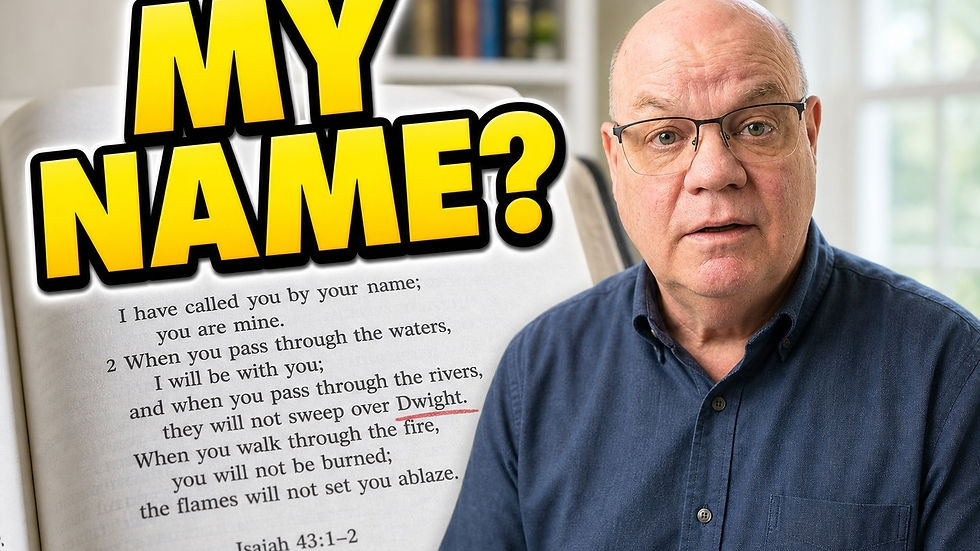
Listen to how Scripture speaks of what God has done for you a sinner in Christ: “In him <your name> has redemption through his blood, the forgiveness of our trespasses, according to the riches of his grace.” (Ephesians 1:7) The passage is for you! Inserting your name into Scripture emphasizes the power of the promise.
Your sin was not overlooked. It was not excused. It was not treated as small. It was answered by the blood of Jesus. The stain you cannot wash away by regret, He has met with His mercy. The judgment you fear has fallen on Him.
Maybe your stomach turns when you remember the message you sent, the door you slammed, the secret you kept, or the face of the person you hurt. Maybe you are afraid to pray because you are afraid God will look at you the way you are looking at yourself right now.
Dear Christian, hear this: your sin is real, and Christ is more real. Your guilt is heavy, and His mercy is heavier. Your conscience may be loud tonight, but it is not Lord. Jesus is.
You do not have to make your sorrow impressive enough to earn mercy. You do not have to punish yourself until God is satisfied. You do not have to wait until you feel forgiven before you believe you are forgiven. God does not anchor forgiveness in the steadiness of your emotions. He anchors it in Christ crucified and risen for you (See: How Living In Forgiveness Changes Your Daily Walk With Christ).
This is not a soft word about sin. It is the only word strong enough for sin.
If God merely said, “It was not that bad,” your conscience would know better. If He said, “Try harder next time,” your conscience would still accuse you of what has already been done. If He said, “Make it right, and then come back,” you would have no peace until every consequence was repaired, every wound was healed, and every relationship was restored.
But God does not reconcile sinners to Himself by pretending sin is small or by waiting for sinners to make themselves clean. He reconciles sinners through His Son.
The cross tells the truth about your sin more clearly than your guilt ever could. It says your sin is so serious that Christ gave Himself for it. And the cross tells the truth about God’s mercy more clearly than your shame ever could. It says Christ gave Himself willingly, fully, and for you.
Paul says it this way: “In Christ God was reconciling <your name> to himself, not counting their trespasses against them.” (2 Corinthians 5:19) This passage also, is for you!
Not counting their trespasses against them. Nor against you!
That does not mean the trespasses were imaginary. It means God Himself has dealt with them in Christ. The debt was not denied. It was paid. The record was not ignored. It was answered by the crucified and risen Lord.
So when your conscience rises up again and says, “God cannot receive you,” answer it with the Word of God. Christ has reconciled sinners to God. Christ has shed His blood for the forgiveness of sins. Christ has risen, and He is not uncertain about the mercy He gives.
Say it aloud if you need to. Not because you are trying to talk yourself into a feeling, but because faith hears what God has spoken and says, “This is for me in Christ.”
That promise does not make sin safe. It makes confession safe. It gives you somewhere to stand when you stop hiding. It frees you to tell the truth without being destroyed by the truth, because the truth about your sin is not greater than the truth about your Savior.
You are not the sum of the worst thing your conscience remembers (See: How to Stop Self-Condemnation Before It Crushes You). You belong to Christ, claimed by His promise, and held by the Savior who did not redeem you halfway.
So pray plainly. Tell the Lord the truth. Confess the sin without dressing it up. Ask Him to teach you to receive what Christ has already won, to put to death what needs to die, and to walk in the light as one who has been forgiven.
And then, as one forgiven by Christ, take the step that love requires.
Forgiveness does not leave you curled inward in shame, and it does not send you back to sin as though grace were permission. Christ forgives and frees. He makes it possible to stop excusing, stop minimizing, stop rehearsing your own defense, and begin telling the truth before God. In due time, and with wisdom, that truth may also need to be spoken to the person you harmed.
You may need to say, “I sinned against you. I was wrong. I am sorry.”
You may need to make restitution. You may need to accept that trust takes time to rebuild. You may need to hear grief or anger from the person you wounded without rushing to protect yourself. Forgiveness in Christ does not erase the real consequences of sin, and it does not demand that another person pretend they were not hurt. It does not require forced closeness or the removal of wise boundaries (See: The Real Reason You Keep Fighting).
But it gives you somewhere safe to stand while you tell the truth.
You stand before God as one for whom Jesus died.
That matters more than you may feel tonight. Your emotions may still tremble. Your memories may still sting. The relationship may still be complicated. The next step may still be costly. But your standing before God does not rest on the tenderness of your feelings, the speed of another person’s healing, or your ability to undo what has been done.
Your standing rests on Christ.
The writer of Hebrews says, “Let <your name> draw near with a true heart in full assurance of faith, with our hearts sprinkled clean from an evil conscience.” (Hebrews 10:22) This passage is for you!
A clean conscience is not something you manufacture by thinking about your sin until you finally feel better. It is not the prize for those who have regretted deeply enough. It is given by God through Christ, who brings sinners near by His blood.
So do not give your guilt the throne. Let it do the work God gives it to do. Let it expose the sin. Let it stop your mouth. Let it end the excuses. But do not let it become your lord. Let it drive you where it is meant to drive you: to confession, to the cross, to the promise of Christ.
That is the distinction you need when guilt feels stronger than God’s promise. Guilt may tell you what you have done, but it cannot tell you who God is toward you in Christ. Your conscience may accuse you, but it cannot forgive you. Christ can. Christ does.
So bring the sin into the light. Tell the truth before God. Make the apology you need to make. Accept the consequences you need to accept. But do all of that as one who is not trying to climb back into God’s mercy by effort or misery. You are coming because Christ has opened the way.
And tonight, if all you can do is whisper, then whisper this: Lord Jesus Christ, have mercy on me. He will not turn away the sinner He came to save. Go in His peace.



Comments